

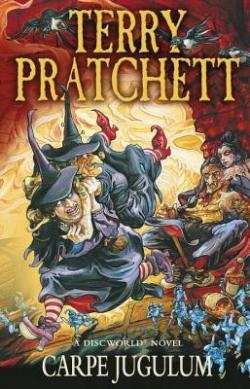
Carpe Jugulum by Terry Pratchett is the 23rd novel in the author’s Discworld series and the 6th book in the “Witches” subseries. It’s a time for celebration in the kingdom of Lancre, as King Verence II and Queen Magrat are celebrating the birth and naming of their first child. Everybody and their mother is invited, from far and wide, though it seems a certain Granny’s invitation has gotten lost in the mail. More’s the pity, as the guest list includes a family of vampires from nearby Uberwald, invited in the name of good diplomacy. Only a fool would invite a vampire into his home, no matter how modern their sensibilities; an invitation from a king into a kingdom puts nearly everybody at the mercy of their influence, meaning the witches of Lancre may have finally met their match.
It’s sometimes dismaying to realize how much time flies; before I read this, it had been almost three years since my last “Witches” novel. In general, I haven’t been keeping up with reading Discworld the way I’ve wanted to thanks to my work schedule, which is what spurred me into finally reading this book. Though it may not be the only one I read this year, if it is, I’ll have lucked out with a really good one. It may be that reading these books at a slower pace has taken away any jadedness in me that had built up, but I think this may be my favourite “Witches” book yet.
In typical Discworld fashion, this novel picks a target for parody, this time around turning its sights on Hammer horror films, mainly through its depiction of the Magpyr family of vampires and the region of Uberwald. They are led by their ambitious patriarch Count Magypr, who has adopted innovative modern thinking to get vampires out of their crypts and unafraid of all the old superstitions that keep thwarting them; as is often the case on the Disc, he takes a mind-over-matter approach that proves garlic, holy symbols, and even daylight might be largely ineffective.
I really liked how much this built upon ideas around the power of belief that the series has explored already. Ditto for the vampires, which have been mentioned in other books as a type of undead, so their introduction here has more of a baked-in quality than the elves from Lords and Ladies. Omnianism, which was most closely explored in Small Gods, and matters of faith play a role through the priest Mightily Oats too, further stitching deeper existing ideas together. This book is hardly the first time Pratchett has made good use of the strong foundation he’d established in other books, but I found that the elements came together especially well in this outing.
I really enjoyed the Magpyr family as villains, especially their smug sense of superiority, feeling as if they’ve won the second they arrive on the scene and circumstances seeming to actually confirm this. Coupled with their “modern” ways of doing things—wherein they completely eschew traditional Gothic trappings and tropes in favour of trying to use good PR and coercion to get mortals to submit to and accept their victimization—made them deliciously detestable. This all made the sentimentality around old Gothic horror tropes that serve as the traditions of Uberwald resonate all the more too, as you can’t help but get swept up by the romanticized take on the adversarial relationship between angry villagers and undead lords brooding in their castles.
Adding to the vampires’ apparent formidability, this novel shows us Granny Weatherwax more vulnerable than we’ve ever seen her. With the newest witch Agnes coming into her own, Magrat becoming a mother, and Nanny already being much older than the others, she finds herself feeling pushed out of her role in their three-witch coven, which is further frustrated by her lost invitation making her feel all the more overlooked/unwanted. Having read so many books about the witches now, it was very affecting to see her so compromised by a very human moment of weakness, leading her to struggle both against a worthy foe and with maintaining her dignity and stature.
Though the horror parody made for good, fun atmosphere, the characters’ personal foibles and struggles with handling such a dire situation were what really made this book something special, deftly balancing fun with more dire stakes. With Granny actually being absent for extended portions of the story, Agnes, Magrat, and Nanny are given a lot of attention, giving the story great balance between their different perspectives. I especially loved seeing how much more firmly Magrat has matured as a character, with nary a sign of the “wet hen” that she used to be. In addition to them, we get the priest Mightily Oats, who has a surprisingly moving arc related to consolidating his faith with his need to ask hard questions and ultimately learning what really matters in the pursuit of doing the right thing.
Final Thoughts
Carpe Jugulum really caught me by surprise; I was expecting good, but what I got was something terrific. Especially if you have a fondness for the spooky and the macabre, the way it plays with classic horror tropes is a lot of fun, and this playfulness is balanced really well with some surprisingly heavy moments that more deeply illustrate the sometimes difficult roles the witches must play in their community, making them worthy of awe. The only caveat I would give with my recommendation is that, unlike many other Discworld novels, this one works best if you’ve read a few or all of the previous “Witches” books beforehand, to better appreciate where the characters are at and what they’re going through.
My Rating: 5 out of 5
 Muse with Me