
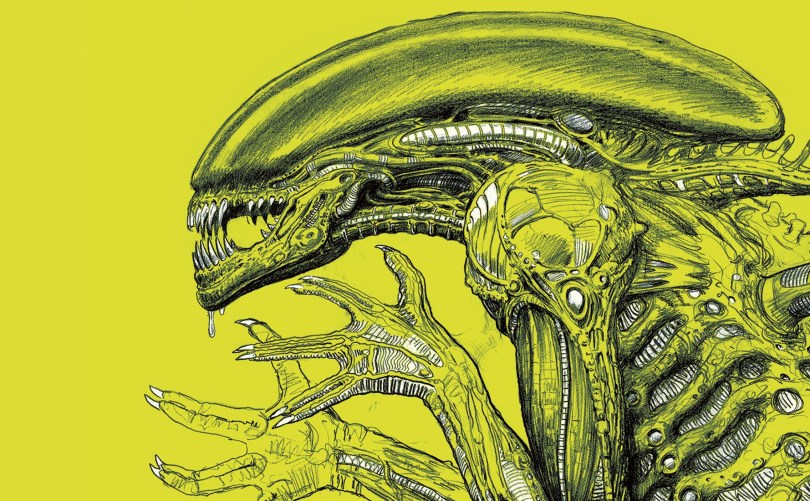

Alien 3: The Unproduced First-Draft Screenplay by William Gibson by Pat Cadigan is a 2021 novel that tells an alternative story to the third film in the Alien franchise. The story follows the fates of Ripley, Newt, Corporal Hicks, and the synthetic Bishop after their narrow escape from the Hadley’s Hope colony and their harrowing encounter with the alien Queen aboard their ship the Sulaco. They thought their nightmare was over, but the aliens are nothing if not relentless; though the Queen was ejected from their ship, she has left something behind that is eager to change and grow. As they try to recover themselves at Anchorpoint Station, it slowly becomes clear that the danger hasn’t ended, but evolved.
Aside from the eye-catching cover art, what really captured my imagination with this book was the history behind it. For those who don’t know, which included myself, William Gibson is the founder of the cyberpunk genre. I had no idea he’d drafted a screenplay for a third Alien film, so the concept was immediately attractive. The Alien films aren’t cyberpunk as such, but they do explore themes that are very fertile for that genre, so it immediately sounded fitting. On top of this, Pat Cadigan herself is an award-winning cyberpunk author, so with her at the helm of a novel adaptation it looked to have a lot of potential. I do like David Fincher’s Alien 3, but it is also a film fraught with issues and characters meeting unfortunately abrupt fates, so I was especially excited to see something alternative. While in some respects I really enjoyed what this book had to offer, I was left with ultimately more mixed feelings than I was hoping.
I think a glaring factor that bears bringing up right away, leaving me happy that this wasn’t the film we got, is the fact that Ripley is put into a coma for the duration of the story, leaving things to be told mainly from the perspectives of Hicks and Bishop. They’re both iconic in their own right, so as a what-if sort of story I was happy to get some more time with them, but nobody puts Ripley in the corner, I don’t care if he’s William Gibson. It’s honestly a baffling decision considering the story serves as a direct continuation of the events of Aliens. I don’t have much more to say on that, her exclusion doesn’t damn the narrative, I just don’t like that choice and it needed saying.
I particularly enjoyed this novel in its first half, which went into a considerable amount of detail fleshing out some more of the politics of the universe, including the introduction of the Union of Progressive Peoples (UPP), a socialist society at odds with the capitalist society of which the colonial marines and the Weyland–Yutani corporation are a part. We’re also nicely eased into the predominant setting, Anchorpoint Station, getting a better look into the lives of civilian workers/scientists and soldiers alike out in space. I got the distinct impression of the story trying to build upon the world established by the previous two films, with good results.
It quickly becomes clear that the biology of the Xenomorphs is acting in a way that’s different from what’s been seen before, with material at the cellular level feeding off of the remnants of Bishop’s synthetic body on the Sulaco, which instigates all that follows. At first, I found myself really getting into this idea, especially as it felt connected to what we’ve seen of the Xenomorph’s origins in the films Prometheus and Alien: Covenant. I especially liked the conjecture from Bishop that the aliens are designed to be a force for violence in whatever environment they’re put into, not an organism that emerged organically. Whether this is Cadigan’s doing to connect the novel with those newer films or if Gibson had these ideas back in the day, I’m not sure. Regardless, it made for a lot of intrigue and good suspense, as I was really unsure of what to expect. It really felt like a good slow burn for a while, as corporate interests in acquiring and exploiting this material were more at the forefront than any action or carnage.
Unfortunately, this all falls away once the station too-quickly falls into pandemonium, and the story increasingly started to feel like a generic sequel to Aliens, focusing too much on the characters constantly fighting for their lives down random corridors. This wasn’t without its excitement—I still enjoyed going along for the ride—but it felt like a complete shift away from the tone the novel had been going for. Also, I couldn’t get over the fact that we spend much of our time with the characters situated in a literal control room, yet we somehow transition from a containment breach to complete and utter collapse without any of the characters being aware of how bad it’s gotten. Nothing felt transitory; it was like a switch was flipped when I would have preferred a more gradual decline.
This could perhaps be attributed to the new mutations of the Xenomorph life cycle, as they ostensibly become a viral contagion, capable of infecting and overtaking a host body until it becomes one of them, but that came with its own problems. I would have been fine with it as a weird anomaly or extreme survival tactic on the part of these organisms, especially as it initially seemed more simply like an unorthodox way for eggs to grow in a new environment without an active Queen, but these infections became so effective that whether or not a character was at risk seemed to be arbitrary. I have no idea how the characters that avoided infection were able to do so, making it all feel more meaningless. It wasn’t a terrible idea, but it was made to be too extreme.
Having read a number of Alien books now, I will say that Cadigan’s writing has been the best, save for something I need to address for a second: she makes it weirdly self-referential. For example, two separate characters internally do a play on “in space, no one can hear you scream” for some reason, and more pointedly, both Bishop and Hicks constantly flash back to events from Aliens and lines that different characters said in that movie. It was kind of nostalgic, as someone who grew up regularly rewatching it, but it also felt too much like pointless fan service and was especially conspicuous with two separate characters doing it, so it wasn’t even an individual quirk.
With that nitpicking stint out of the way, I really did like the little corner of the universe she built here, and the slow parts of the story during the first half that were focused more on intrigue and the aliens as an imminent threat made for some great science fiction. She also captured the voices of Hicks and Bishop really well, which has earned this book higher esteem than it otherwise would have, as I was effortlessly able to imagine Michael Biehn and Lance Henriksen in their respective roles. I especially liked Hicks as a character growing up, and it always bothered me how unceremoniously he met his end; her skilled adaptation of the character into this what-if story helped to keep me invested when the plot got weaker.
Final Thoughts
As an alternative sequel to Aliens, this novel’s adaptation of William Gibson’s first-draft screenplay makes a worthy effort but doesn’t quite present something good enough to replace the Alien 3 that we got; I attribute this more to Gibson than Cadigan, who put together a good novel here with his ideas. However, hearing that Gibson’s second draft is more similar to Alien in tone, with much fewer aliens, has me wishing Cadigan had adapted that version instead. Still, if you’re interested in a story that fleshes out more of the franchise’s universe and gives you more with Hicks and Bishop, it makes for a decent read that does a good job of tapping into some nostalgia for the franchise.
My Rating: 3 out of 5
 Muse with Me