
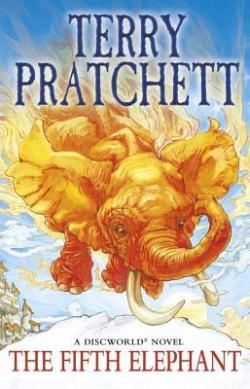
The Fifth Elephant by Terry Pratchett is the 24th novel in the author’s Discworld series and the fifth novel in the “City Watch” sub-series. Sam Vimes, commander of the Ankh-Morpork City Watch, lives a life fraught with danger, pursuing hardened criminals throughout his notorious and modern city and dodging assassins sent by those with distaste for such a committed man of the law. He is about to face his toughest challenge, however, when made to step into his role as a Duke and play ambassador to the mysterious and filthy-rich country of Uberwald, a place that follows its own rules in deference to the various figures who hold power there. Politicking may not be his forte, but with a sacred dwarf artifact going missing and murders piling up, a no-nonsense policeman may be just what the place needs, if only he can keep the wolves from snapping at his heels.
The last “City Watch” book I read was Jingo, and at the time it seems I wasn’t especially enthused about reading another book in this sub-series so soon after the previous one. It’s funny to reflect on where my mind was at in that review—written well over two years ago—because this time around it just felt like reuniting with old friends. Though the Discworld as a whole has many great recurring characters, there is something special about the diverse and numerous characters that make up the Ankh-Morpork City Watch. Better yet, this book brings us once again to the Old-World-horror-themed country of Uberwald after being exceptionally featured in the previous book Carpe Jugulum.
This novel seems to be starting a trend with this sub-series, taking our characters beyond the city walls and having them contend with politics beyond simple police work, though there is still murder and a high-stakes burglary at the heart of this story that need solving. Though I liked Jingo quite a bit, despite feeling that the characters were a little too static, I was surprised to find myself feeling a lot more strongly about this one, though one subplot was a little weaker than the others.
For the first 100 pages or so, I felt differently about this book, as it was off to a much slower start. I had trouble getting a feel for what it would be all about, as the story took its time getting the characters into Uberwald and establishing everything that was at stake. It turned out to be a really good slow burn, however, deftly laying the groundwork for the delicate politics and different factions of this less “modern”, more ruthless and unforgiving country steeped in competing traditions.
In many ways, this story is about tradition and identity and the friction caused when changes in identity clash with upholding said traditions. This is illustrated well with Vimes alone, who can’t truly escape his role as a copper, a job with which he firmly identifies, yet must due to his role as a Duke, awarded to him thanks to his marriage. It is in his marriage to Sybil, in fact, where he must firmly find a way to let go of being a cop sometimes; it’s never been in doubt that he loves his wife, but this novel more particularly explores how he must learn to be something more for her and learn to let go of his professional impulses, his brushes with death against werewolves, vampires, and dwarf extremists putting some things into perspective for him.
Change and identity are explored even more interestingly through the world building that Pratchett accomplishes with the werewolves and dwarfs. For the former, I think it is summarized best by paraphrasing an idea put forward: “Wolves don’t like werewolves because they’re wolves that act like humans, in the same way that people don’t like werewolves because they’re humans that act like wolves.” So simple a breakdown of these things as beings, yet surprisingly profound, despite being disparaging. Though ultimately fantastical, it speaks to our tendency to want to separate things into either/or terms, an impulse the werewolf characters themselves reckon with as well, as some of them struggle to balance the impulses of their forms.
For the dwarfs, we get a closer look at what a traditional kingdom of theirs is like, the respected positions among those who hold the most dangerous jobs when traversing/expanding the depths of the earth, and just how rigid yet nebulous their values can be when it comes to whether or not somebody is a dwarf (as a matter of identity rather than species). Some believe moving to another country alone disqualifies you, adding to the tensions around the new king being crowned. Matters of dwarf gender are further explored and elucidated in this book too, which I continue to find especially fascinating.
To explain briefly, there are male and female dwarfs, but they’re a uni-gendered people, with every member looking identically masculine and using he/him pronouns. Female dwarfs in Ankh-Morpork, however, have taken to adorning themselves in more feminine ways like human women do, which many traditional dwarfs find intolerable. Though an appreciated staple of the fantasy genre, I’ve never had a particular fondness for dwarfs, but Pratchett’s interpretation has continually added cultural depth that I really love.
The only facet of the novel I found to be a little weak was concerning Captain Carrot and Sergeant Angua, the latter going off into Uberwald separately from Vimes to confront her family and the former following after her. Though I found an aspect of this subplot hilarious, as Angua is traveling with a wolf named Gavin who seems to be a potential rival for her affection—since her nature as a werewolf means a relationship with either a man or a wolf is equally as sensible—it wound up being a lot more peripheral to the main story with Vimes than I was hoping; they seemed to be taking forever running about the wilderness instead of actually contending with Angua’s family. If not for their intervention at a crucial moment of distress for Vimes, their part in the story would be completely pointless, which is a pity considering I thought Angua would have more direct involvement in a story like this that is so concerned with the machinations of her family.
Final Thoughts
Though I rate them all fairly highly when all is said and done, I liked this City Watch novel a bit more than the last couple, which is saying something considering I think they’re all pretty rock-solid books, for the most part. Pratchett’s comedic writing is on point as always (an obligatory remark I feel I have to leave somewhere when its true), and the more dramatic aspects of the characters’ development and plot especially hit home. Parts of this book stand as shining examples of how talented Pratchett is at world building despite this series being a parody of fantasy worlds too; even while he’s having a laugh, he makes it deeper than you’d expect.
My Rating: 4.5 out of 5
 Muse with Me