
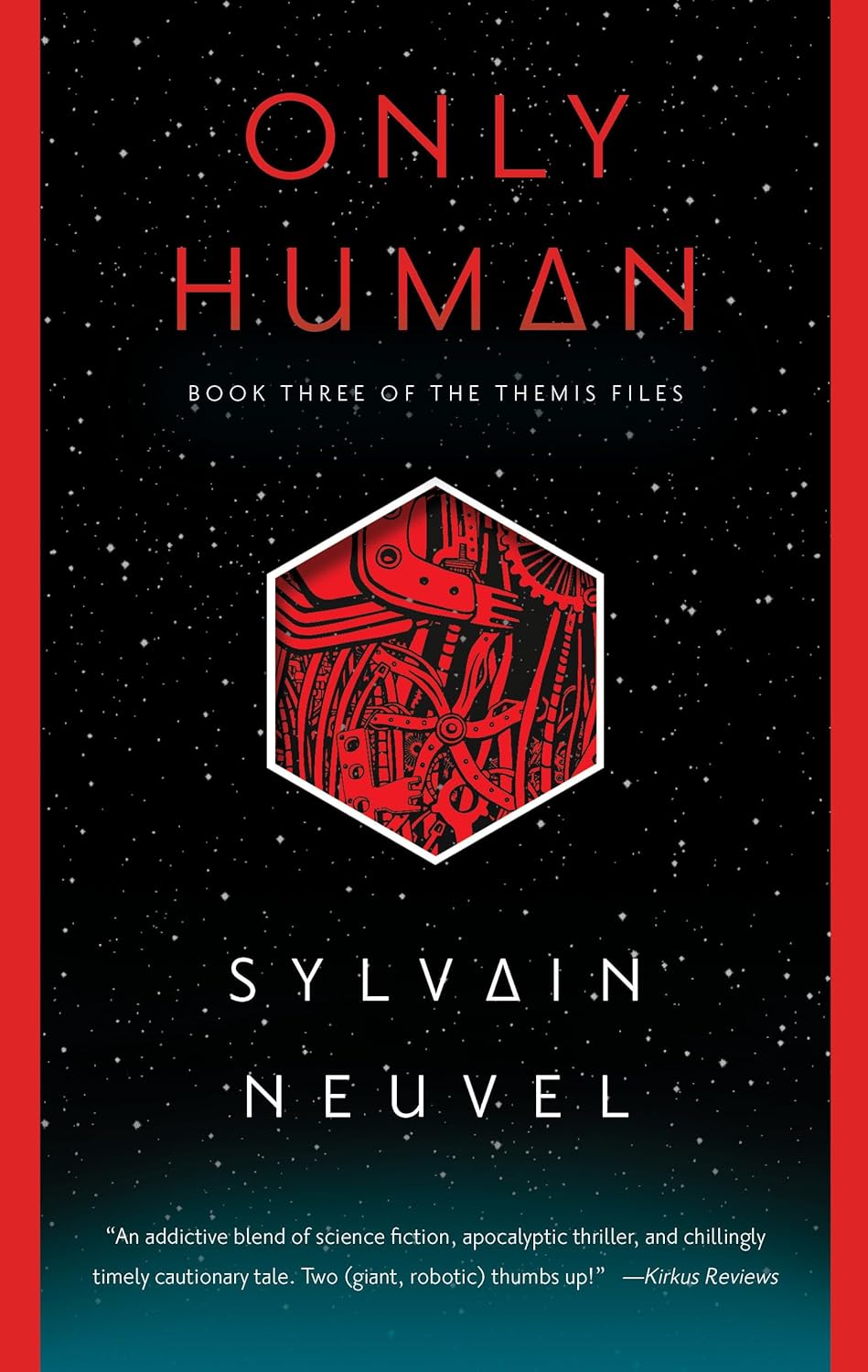
Only Human by Sylvain Neuvel is the third and final novel of The Themis Files. For the past ten years, Rose, Vincent, and his daughter Eva have been stuck on an alien planet. Through Rose’s ingenuity, the alien invaders who made Themis and massacred 100 million people were persuaded to leave Earth, taking their creation with them. Unbeknownst to them, however, Rose and company were celebrating inside Themis when she was beamed away. Though initially prevented from leaving, Rose, Vincent, and Eva have managed to make their way back to Earth using Themis, where they hope they can finally return to living a normal life. Things are never quite that simple, however, and 10 years is a long time following so much destruction and so many lives lost. Humanity and their understanding of who they are in the universe has forever changed and must be reckoned with before peace can ever be attained again.
Though I think this novel does a better job of recapping the reader on what happened in the previous book, I sought to better clear the hurdle I faced getting into Waking Gods by reading this book soon after, and I’m happy that I did. With everything fresh in my mind, it was easy to get right back into the narrative, which picks up fairly seamlessly where the second book leaves off, even going over the final scene from that book once again with added details.
Unlike the previous novels in this trilogy, there is a bit of a structural change to the narrative in this one that helped refresh things a little. Typically, we are presented with interview transcripts, diary entries, reports, etc., in more or less chronological order. While that is ostensibly true here as well, the timeline of the narrative is split in two: we are given transcripts of the characters’ time on the planet Esat Ekt and the events leading to their return to Earth over ten years or so, and we are given accounts of what transpires after they return to Earth. The narrative jumps back and forth between the two, slowly revealing how their experiences on another world impacted them and what the true intentions of the Ekt may or may not be.
This introduced a compellingly different element to this novel, distinct from its predecessors, but I can’t help but feel that the divided attention split the narrative in a detrimental way too, especially since the 10-year span that they’re on Esat Ekt doesn’t have much bearing on the plot on Earth, especially as it’s relatively bereft of conflict, just a longing from some of them to return home. On Earth, people are being put into camps based the prominence of any alien genes they may have, and the United States military has repaired the inert robot from the invasion and is abusing its power in order to control other nations. I feel you could develop these ideas into two separate novels, but instead this novel must balance both, with varying degrees of success. The ideas at play are very good ones, Sylvain is excellent at formulating compelling science fiction, but the limitations of the epistolary format were a little too apparent this time.
Adding to this, this novel has the absolute absence of the trilogy’s most grounded presence. Referred to by others as “our nameless friend”, the bold text of his dialogue operated as the counter voice in most of the interview-based chapters, serving as a point of consistency for the reader. In Sleeping Giants especially, his presence was a grounding one, impersonal but authoritative and challenging, showing us a range of perspectives and taking us into classified places with high-level people of all kinds. Though the novels have central characters, it felt more appropriately like we were piecing together the narrative thanks to these files, with the people feeling more like key figures in developing world events and less like characters in a story.
Our nameless interviewer died halfway through Waking Gods, and while this added some serious stakes to that novel and showcased the true gravity of the situation they were facing, nobody really stepped up to the plate to fill his shoes. Rose is asked by him to maintain “the Themis Files” before he dies, but only really to justify why there are any files left for the reader to continue the narrative through. I had hoped she would come to act like him more, with her own personalized approach to it, but she never really does. I do think her chapters in Only Human are some of the best, especially her struggles with navigating the Ekt’s non-interventionist ideology, dipping her toes into sciences outside of her own expertise because they have cures and advancements that would be considered miracles on Earth, but she never feels like somebody of authority in the same way.
Instead, despite the global humanitarian crises and geopolitical conflicts, this novel feels more concerned with the drama between Vincent and his daughter Eva. While her displeasure with being returned to Earth is an interesting angle, they’re such thoroughly unserious people that I felt the emphasis on their personal drama was a little too much. This novel in particular made it feel like the story was about these characters with world events as the backdrop, rather than them being important figures on a grand stage as the world fundamentally changes around them, and I just had trouble buying into it. Adding to this, the resolution to the broader conflict made sense, but in execution it felt contrived, perhaps even a little too convenient.
Final Thoughts
Despite my issues with Only Human, I still liked this book. Their time spent on the alien planet painted an interesting picture of a civilization that operates on principles quite different from our own, while still being familiar enough to relate to. The state of the world that the characters have to contend with felt very organic as fallout to the events of the previous book, and I can’t pretend I didn’t care about these characters at all, I just wish it had somehow retained a firm, impersonal, central perspective to keep things more grounded to the original idea tying everything together. Before, we were getting glimpses into different facets of a developing situation through the records kept by someone with a vague yet focused goal; here, we read audio log transcripts where I have to question why anybody was even recording in the first place. It’s unfortunate that the strongest book in this trilogy is the first one, but it’s still well worth your time to see it through to the end; I could easily see some of my negatives being positives in the eyes of another reader.
My Rating: 3 out of 5
 Muse with Me