
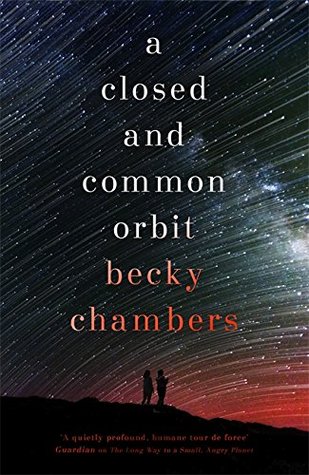
A Closed and Common Orbit is the second novel in the Wayfarers series by Becky Chambers. During the events of the first book, the spaceship the Wayfarer suffered damage after an attack, compromising the ship’s AI. The crew failed to reboot her with her memories intact, so “Lovey” effectively died, leaving only Lovelace, the AI operating at factory settings. Lovey’s crew, alongside her human lover Jenks, were too grief-stricken to keep Lovelace with them, so they uploaded her into the android kit they had illegally intended for Lovey to use, and she left under the care of a close friend of the crew. Lovelace, giving herself the new moniker of Sidra, must now navigate living incognito as a human being, an existence far outside of the remits of her programming (and comfort) and one actively dangerous for herself and her new friends, should her true nature be uncovered.
Despite the fact that I sincerely loved the first book, The Long Way to a Small, Angry Planet, it took me an unusual amount of time to actually read this follow-up novel. Fortunately, the books in this series seem to be only loosely connected to each other, so the gap in time between reading them had no hindrance on my ability to get into this one. The loss of Lovey was an impactful moment from the previous book as well, creating a fertile launching point into a new branching story. It certainly helps to have read the first novel, but it isn’t necessary. All the background information you need to know is laid out efficiently at the start, and while her situation is not one most of us could relate to firsthand, the dilemma of needing to adapt to an unfamiliar, discomforting body is viscerally understandable and sympathetic.
Despite the potential depths to be explored with Sidra’s situation, I was surprised to find that this novel is not as singularly focused on her experiences as I had thought. Sharing the spotlight is a flashback narrative about Sidra’s friend and ostensible guardian Pepper, formerly Jane, telling of her experiences growing up as a clone slave on an oppressive human world that keeps itself separate from larger galactic society, where she escapes the facility enslaving her and survives in the surrounding junkyards raised by Owl, the AI of a damaged and abandoned ship. The novel alternates between the two narratives, eventually tying the two together.
Herein lies a problem I have with this book. Despite how well I think these stories are told and tied together, I think Pepper’s life growing up actually steals the spotlight from Sidra almost entirely. Even though I already know Pepper somehow escapes her situation, the lion’s share of the tension lies with this narrative over the one in the present, as some chapters are fraught with natural tension in what unfolds and it is quite unknown what has become of Owl, seeding anticipation for what happens later. Meanwhile, there are glaring factors related to Sidra’s situation that feel far too glossed over. For instance, at one point she needs to learn a coding language in order to reprogram herself so that she can actually lie to people (and thus better hide that she is an AI), enrolling in a university class to gain the ability to do so. This could’ve been a great way for her to be challenged by a new environment, but she succeeds off the page; we merely see her seeking enrollment and then her subsequent self-reprogramming.
Furthermore, there’s an issue to her whole situation that I think is criminally not addressed: Sidra never wanted this. She is excruciatingly uncomfortable being in a humanoid body a lot of the time, despite enjoying some of the new experiences she’s had, and I feel the crew of the Wayfarer actually bears a lot of responsibility for this situation. Their ship will need a new AI, surely. Could they not have modded her voice and left it at that? Even if that’s illegal, crossing legal lines was clearly not a major concern for them. My memory of the specifics is a little spotty—in fact, I needed reminding that Sidra explicitly consented to going along with this and being sent away—but was subjecting a sapient being to bodily dysphoria really the optimal choice here? I really think there ought to have been some sort of reckoning about this, and I’m disappointed that there wasn’t.
These problems notwithstanding, I did still find myself satisfied with Sidra’s journey and where she ends up, especially the ultimate culmination of her asserting her sense of self. Chambers does a great job of telling character-driven, lower-stakes stories, and while the threat of greater trouble always loomed over the different story threads, it was refreshing that what the characters must overcome is allowed to be smaller and more personal. It also introduces dilemmas that hadn’t ever occurred to me with characters of a synthetic nature like Sidra that feel deeply realistic, such as the limitations of her memory and what she can or cannot do to mitigate that, which I find to be a testament to the author’s ability to world build in science fiction.
Additionally, though I was a bit perturbed with Pepper’s backstory taking so much of the spotlight away from a fertile story line that could’ve been a book all on its own, it was a great deep-dive into somebody living in a small, forgotten, and exploited corner of a greater universe, oblivious to all the wonders that could be accessible to her. It served well as a stark reminder of how certain technological marvels can result in new and terrible ways for people and things to be mistreated or exploited as certain advances allow people to blur the lines between what is a person and what is not. Different species intermingle and share culture, space travel is accessible to the common person, and people can modify themselves with technology in wonderful ways, but here is a little girl cobbling together an electricity gun so she isn’t eaten by packs of feral dogs in a junk yard the size of a city, regarded as having no more value than the refuse around her.
Final Thoughts
Though A Closed and Common Orbit won’t stay with me the way the first book did, I still really enjoyed this novel. The characters are really well realized, the science fiction is really well thought out, and it does an excellent job of giving an up-close look at the lives of everyday people in a galaxy with a scale that rivals that of mainstream, bombastic space operas. I only wish this book had allowed itself to immerse more deeply into the experiences of its central character and grapple with the actions of the previous cast rather than spend so much time on a new character’s backstory, even if it was compelling in its own right.
My Rating: 3.5 out of 5
 Muse with Me