
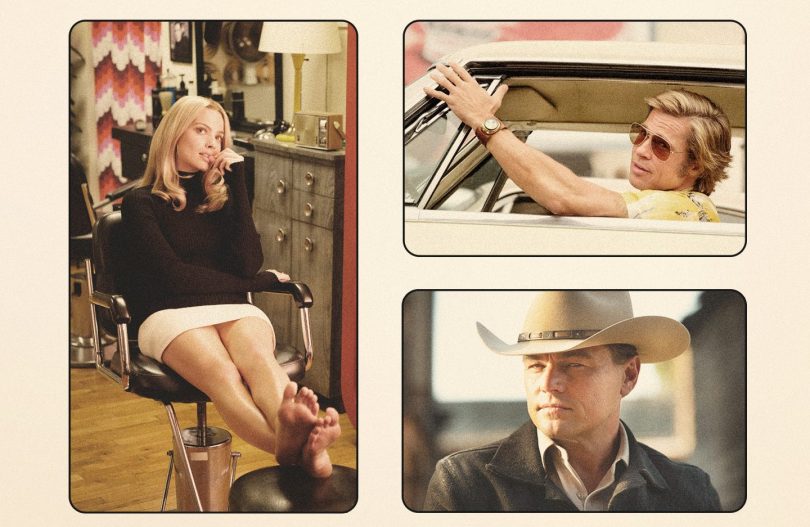
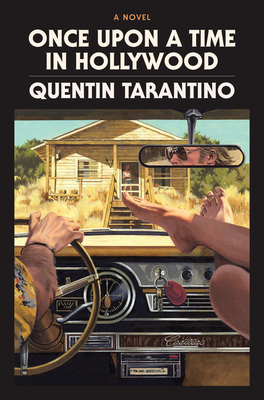
Once Upon a Time in Hollywood by Quentin Tarantino is a novel adaptation of the author’s 2019 film of the same name. Set in Hollywood in 1969, it tells the story of Rick Dalton, a washed-up TV actor who used to be a big star on a Western series from the late 1950s to the early 60s called Bounty Law. After a brief stint in movies, where he tried to elevate his career from TV star to movie star, Dalton is now relegated to playing guest spots as the “heavy” in different shows, where the next big faces in TV get to look good by defeating a recognizable has-been hero. As an opportunity to travel abroad and star in Italian Westerns is presented to him, Dalton must come to terms with where he is in his career and what he wants out of the future. Inter-cut with his story is a colourful, sometimes sinister, cast of characters who have all carved out their own little worlds in Hollywood and strive to make their own dreams a reality—or simply make do with what they’ve got.
I first saw the film Once Upon a Time in Hollywood while it was playing in theatres back in 2019. Though it wasn’t my favourite among Quentin Tarantino’s films, it stood out as something more unique after his previous two, especially in the way that it told an alternate history around an infamous case of true crime. It was only a year or so ago that I even heard there was a novel published based on the film, written by Tarantino himself no less. What I’d heard at the time was that the book reaches the film’s end only part way through and then keeps going. While I now know that that isn’t exactly the case, it was a tantalizing enough prospect to get me to eventually borrow this book from the library. First, I made sure to rewatch the film, and then I dove into this alternative take on the story.
While technically speaking this book is a novelization of the film, I was struck very early on by how much it really doesn’t feel like one. In typical fashion, a novelization tells the same story as the film, taking advantage of the change in medium by offering deeper insights into the characters’ thought processes and points of view, perhaps with some added scenes sprinkled throughout to expand the narrative a little. This novel does follow the story of the film, in a way, but is also very disinterested in following its narrative beats, even eschewing the climax of the film entirely. Not only does it end on a completely different note at a completely different point in time in the story, the climax of the film is only mentioned at all in a tangent that flashes forward, this tangent taking place within a chapter that is only a quarter into the entire book. After that, the incident is not referred to again, making the film’s more conspicuous alteration of history more of an afterthought.
While the book does follow a coherent enough thread from beginning to end, it functions best as a companion work to the film rather than an alternative way to engage with that story; I don’t think this novel can truly be appreciated unless you’ve seen the film first. I suspect that this novel only really exists to flesh out aspects and characters of the world of the film that had to be cut for time (photos included in the edition I read suggest a number of sequences in the book were shot but didn’t make final cut) or that would be too tangential and indulgent for inclusion in the film.
Indulgent is an appropriate word for many parts of this book, especially when it comes to Cliff Booth, Rick Dalton’s stunt double, driver, and general gofer. While Rick feels more or less the same as his film counterpart, just with his thoughts and feelings more clearly represented, a lot about Cliff is expounded upon. The most indulgent aspects with Cliff are how much Tarantino gets into his tastes in movies. While these dives into cinema, especially his love of foreign films, were interesting enough to me, they serve virtually no purpose to the story whatsoever, so your mileage may vary. I got the strong sense Tarantino really just wanted to talk more about cinema of the time and used Cliff as a vehicle to do so.
On top of these digressions, we are also treated to a lot of Cliff’s backstory, which is representative of the purpose many chapters serve in this book. Details that are merely touched upon in the film, such as his military exploits and him possibly having murdered his wife, are covered in much more explicit detail, characterizing him much differently from what we see in the film. In the film, he’s a true man of action with a laid-back attitude towards life that makes him undeniably cool, in contrast to Rick, who plays such men on screen but in reality is a much more flawed and anxious man. Cliff Booth in the book, while still embodying what we see on screen, is ostensibly a psychopath.
Many of the characters are given such treatment, some of whom really only played minimal parts in the film. Though a number of their stories end unceremoniously or are simply not picked back up again, it is the novel’s relationship with the film that really matters. For example, Charles Manson only appears very briefly in the film, but here his scene is included in an expanded section told entirely from his perspective, fully laying out his aspirations at that point in time and his reasons for showing up at the Polanski residence. On its own it’s perhaps a weird detour within the novel, but it allows greater insight into the goings-on in the film. This section does a lot to dissolve the real-world infamy around Manson too, emphasizing how much he was an abusive, manipulative, fame-hungry loser desperate to become a star by any means necessary.
A part I really enjoyed being expanded upon was Lancer, the latest pilot project Rick is appearing in as the heavy, this time around as a “land pirate” cattle rustler named Caleb Decoteau. Though we see plenty more of Rick and his costars on set as we see in the film, we are also given much greater detail into what the show is actually about and who the characters are. We are treated to chapters that go a narrative layer deeper, presenting Lancer and its world as its own work of fiction with no reference to the production whatsoever. I really enjoyed how this mirrored scenes in the film where we see Rick playing Caleb, where you can become so immersed you forget the narrative frame of the TV show production above it. How much thought Tarantino put into this fictional production is really illustrated here, such that I would now really enjoy seeing it given a full life of its own.
Final Thoughts
Once Upon a Time in Hollywood is good but not great, most pointedly because it does not really stand on its own as a satisfying novel. It is, however, an excellent companion piece of media to a great film. Also, while Tarantino is a great filmmaker, he isn’t as great of a novelist, especially in how he can sometimes get carried away, making some sections more of a slog to get through. If you really enjoyed the film, you will see value here like I did. Otherwise, you should see the film and then decide for yourself if the deeper background details of this world and its characters and their internal lives are worth being expanded upon.
My Rating: 3 out of 5
 Muse with Me