

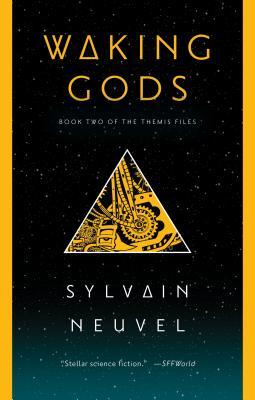
Waking Gods by Sylvain Neuvel is book two of three of The Themis Files. It has been ten years since Themis, a giant robot found in pieces around the world and painstakingly reassembled, was turned over to the United Nations, founding the Earth Defense Corps, which stands on guard to defend the world against extraterrestrial threats. Though Kara and Vincent, the only people known to be able to pilot Themis, are living well in their renowned positions, physicist and Themis expert Dr. Rose Franklin has struggled to come to terms with her existence, having mysteriously re-emerged five years younger than she was when she died during an explosion at Denver Airport. Her brilliant mind may not have the luxury of such a personal crisis, however, as a second, larger robot suddenly appears in London, intent on destroying Themis on sight. Unless she can figure out what these visitors want, the very future of humanity may be at risk.
It was regrettable that I did not start this book soon after Sleeping Giants; I think the format, conveying the story through interview transcripts, log entries, broadcasts, etc., perhaps does not lend itself very well to catching the reader up on everything that happened previously, since it might come off as too awkwardly expository. Maybe it’s simply a shortcoming on my part, but it took a little while for me to fully recall where a lot of the characters left off or sometimes who they even were. I won’t be making the same mistake going into the final book.
I think one of the understandably necessary but unfortunate aspects of this story is that it takes place 10 years after the events of the first novel, which is only really in service of allowing one key character to actually have a role to play. Otherwise, it is unclear to me why the arrival of the second robot did not happen much sooner. I think that this is actually what threw me off at the outset, that for 10 years Vincent and Kara had been touring around and living on a ship with Themis like celebrities, but I had no recollection of any major battle in the first book, least of all with aliens. With no major accolades fitting their purpose, surely the novelty would have worn off. Meanwhile, seemingly no major breakthroughs have been made with operating Themis in all this time either, especially as a key function for mobility isn’t figured out until this book, where it is mostly used as a plot device to keep characters separated and out of the action.
It’s understandable that Rose is still wrestling with an existential crisis, but it still feels as though it just happened, rather than there being an intervening 10 years to learn to accept it at least a little, even without fully coming to terms with it. I do have a greater fondness for Rose overall, however, especially since she has one of the more crucial roles to play in this novel, and the philosophical musings about the nature of existence and who and what she is were some of the most fascinating parts of this story. Still, it sticks out a little too much how, despite a ten-year time skip, they made far less headway in understanding Themis than they did in the entirety of the first book, and everybody is more or less the same as before the intervening years.
For the better part of the first half of this novel, I honestly had a hard time feeling all that invested. Themis’s first bout against an enemy robot was fun enough, but by the time the conflict escalates, Kara and Vincent aren’t available to try and deal with them. The mystique around the alien invaders’ motives added some good tension, but a full appreciation of the stakes eluded me, and Kara and Vincent’s plot, though an understandable diversion for them, felt like it distracted a little too much from the greater threat.
A turning point was reached around the latter half of the novel, however, where the true magnitude of the threat faced by humanity truly sunk in, with meaningful, permanent consequences faced by our characters. The story really had its hooks in me a lot more firmly from this point forward and largely redeemed the weakness of the first half, propelling me through the rest of the novel a lot more quickly. The reasons behind the aliens’ attacks were fascinating to consider at a philosophical level as well, bringing up thought-provoking ideas about the burden of responsibility that comes with alien visitation of other intelligent life, helping the reader to understand where they’re coming from while not detracting from the urgency to save the world.
The sense of dread and desperation became palpable in a way that reminded me of the strengths of the first novel, where Neuvel clearly loves the idea of people piloting giant robots but shows restraint and instead considers the real ramifications of such technology existing and being operable in the hands of modern day humanity. We’ve got Themis now and pilots that can operate her, but so what? There are dozens of theirs against one of ours. What can we possibly do against technology completely unfazed by our own?
Final Thoughts
Though the second half was really strong, with a solid and credible ending, I was a little let down by the epilogue, which felt more like a contrivance to help set up the final novel than something that flowed naturally with the rest of the story. Having had a glimpse at what’s to come, however, I’m rather looking forward to the next phase in this story and the greater consequences of what humanity has learned about itself. Overall, Waking Gods was weaker than its predecessor but is nonetheless a solid sequel that has me excited to see the trilogy through.
My Rating: 3.5 out of 5
 Muse with Me
OMG I just started this series! Twinsies!
I hope you enjoy it too!